

Pastor Ken
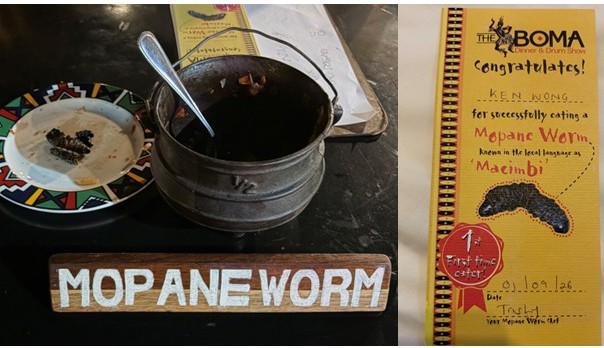
While we traveled in Zimbabwe recently, we attended a dinner show for tourists. It was a buffet, with all kinds of game meats, including a whole roast lamb, and various kinds of offal. When guests entered, the servers helped drape a shawl diagonally across each person’s body, as a way of dressing like the local people. Toward the end of the meal, there was live music and dancing as part of the cultural presentation. In the middle of the restaurant stood a small round table with a little metal pot on it. A sign beside it read “mopane worm.”
The mopane worm is the caterpillar of the emperor moth. It feeds mainly on the leaves of the mopane tree and grows to about one or two inches long. If allowed to mature, the moth can have a wingspan of more than four inches—a remarkably large insect. The black worms served to tourists at dinner had already been cooked and seasoned with spices.
For most tourists visiting Africa for the first time, eating one is a bit of a challenge. Those willing to try it could eat a whole worm and then open their mouths to show the server that they had swallowed it. In return, they received a certificate. I received one such certificate to prove I’ve eaten a worm.
Afterward, many friends asked me what it tasted like. Did it burst and ooze juice when I bit into it? Actually, the caterpillar is about 60 percent protein. Once cooked, its center has a powdery texture somewhat like an egg yolk, while the other parts taste crispy. The original flavor was mostly masked by the spices. Well, to me, once was enough.
Mopane worms can be found in many countries in southern Africa. In rural areas, it’s a common food. When the caterpillars are fully grown, women and children go out to collect them. After being cleaned, they’re dried and stored for later use. Some commercial farms raise them and turn them into a multimillion-dollar agricultural product that can be bought in local markets.
People in different parts of the world always harvest whatever their environment could provide in order to survive. Many years ago, I bought a used cookbook that contains the recipes of early European settlers in America, including instructions on how to kill and prepare squirrels, rabbits, raccoons, and other animals. Two or three hundred years ago, people’s tastes were clearly different from ours today. More importantly, folks often had very little choice about their food supply.
For much of human history, people believed blood was where life resided. That is why the Bible teaches against eating the blood of animals to avoid mixing human life with animal life. The broader principle is that for those who believe in Jesus, life belongs to the holy God, and we should have a higher moral standard and a different lifestyle than outsiders. We shouldn’t establish relationships with pagan gods or idols, nor should we have intimate relationships with anyone outside of marriage.
Regarding food, as long as it is beneficial to health and it fits within the cultural practices of the time and place without affecting one’s conscience or another person’s faith, all living creatures may be eaten. As 1 Timothy 4:4–5 says, “Everything God created is good, and nothing is to be rejected if it is received with thanksgiving, for it is made holy by the word of God and prayer.”
People who are accustomed to cooked food may find raw seafood or meat difficult to swallow. Vegetarians may feel nauseated by the smell of meat. And someone like me, who is accustomed to the everyday diet of Western society, may regard insects and reptiles as dirty or unfit for eating. It’s quite interesting to try an unfamiliar food once in a while. But if I have a choice on the quality and quantity of my everyday meals, I still prefer to eat from a nutritional perspective.